PVC Tape vs Electrical Tape: How to Select the Right Insulation Tape for Your Project
1. Start with Procurement Misconception
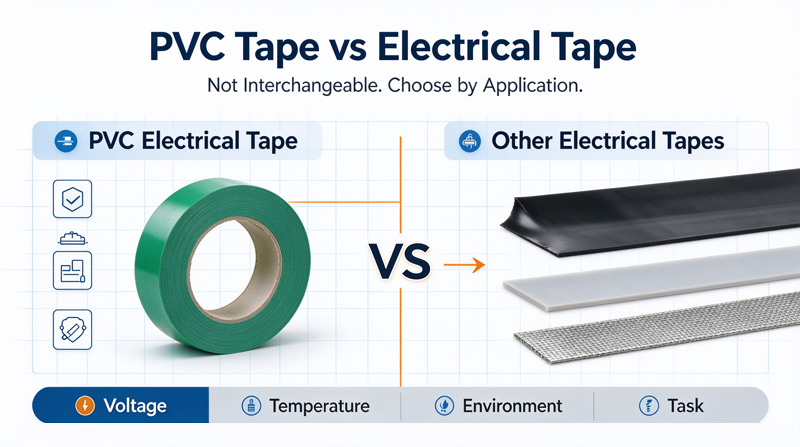
“PVC tape” and “electrical tape” are frequently mixed in inquiries and purchase orders. A lot of purchasers assume they refer to one identical product. This misunderstanding may lead to wrong material selection, on-site failure or rework cost.
2. Concept Breakdown: Classification, Not Simple Definition
Electrical tape is a broad category covering all tapes designed for electrical insulation. It is not a single material product.
- Sub-types of electrical tape: PVC electrical tape, EPR self-fusing rubber tape, silicone electrical tape, glass fiber tape, etc. PVC tape is one member inside the electrical tape family. When people mention PVC tape in wiring projects, they usually mean PVC electrical insulating tape.
3. Engineering Parameter Comparison
| Item | PVC Electrical Tape | General Electrical Tape (Other Material Types) |
|---|---|---|
| Base Material | PVC film + pressure-sensitive adhesive | EPR rubber / Silicone / Fiberglass |
| Working Temperature Range | -10℃ ~ 70℃ | EPR: -40℃ ~ 90℃; Silicone: up to 200℃ |
| Voltage Rating | Low voltage, common 600V | Wide range: 600V ~ 10kV and above |
| Waterproof Performance | Splash-proof, not for continuous immersion | EPR self-fusing type: fully waterproof after amalgamation |
| Stretch & Self-fusing | Stretchable, no self-amalgamation | Self-fusing rubber tape bonds to itself without adhesive |
| Typical Application | Wire harness wrapping, low-voltage cable insulation marking | High voltage cable splicing, underground cable repair, high-temperature equipment |
4. Common Procurement Pitfalls
- Pitfall 1: Search “electrical tape” and directly order PVC tape for 10kV cable joint. PVC tape only supports low voltage and cannot bear high voltage load.
- Pitfall 2: Expect PVC tape to work under long-term high-temperature environment. PVC will soften, deform and lose adhesion.
- Pitfall3: Treat all electrical tape as waterproof. Standard PVC electrical tape can not be used for underwater or buried cable sealing.
5. Selection Decision Model
Answer these questions to find your suitable tape:
- What is your working voltage?
- ≤600V, normal ambient temperature → PVC electrical tape
- Medium / High voltage (above 1kV) → choose EPR self-amalgamating rubber tape
- What is continuous working temperature?
- Below 70℃ → PVC tape
- Over 90℃ → silicone electrical tape
- Does it need waterproof sealing or buried installation?
- Yes → EPR self-fusing rubber tape
- No, just surface insulation binding → PVC electrical tape
- Application scenario: auto harness / domestic wiring / cable joint repair?
- Auto wiring harness & low voltage wiring: PVC tape
- Cable splicing & underground cable repair: self-fusing rubber tape
6. Final Conclusion
There is no universally “better” tape. The right choice depends fully on your project parameters and application environment. PVC electrical tape is the cost-effective option for most low-voltage indoor & automotive wire harness wrapping. For high voltage, high temperature or waterproof buried cable projects, you need to pick other electrical tape materials instead of PVC tape.
Black vs White PVC Insulation Tape: Color Coding Standards & Engineering Application Guide
Unified Terminology Guide for PVC Electrical Insulation Tape: Eliminate Cross-Border Procurement Miscommunication & Wrong Selection Risks
Related Article